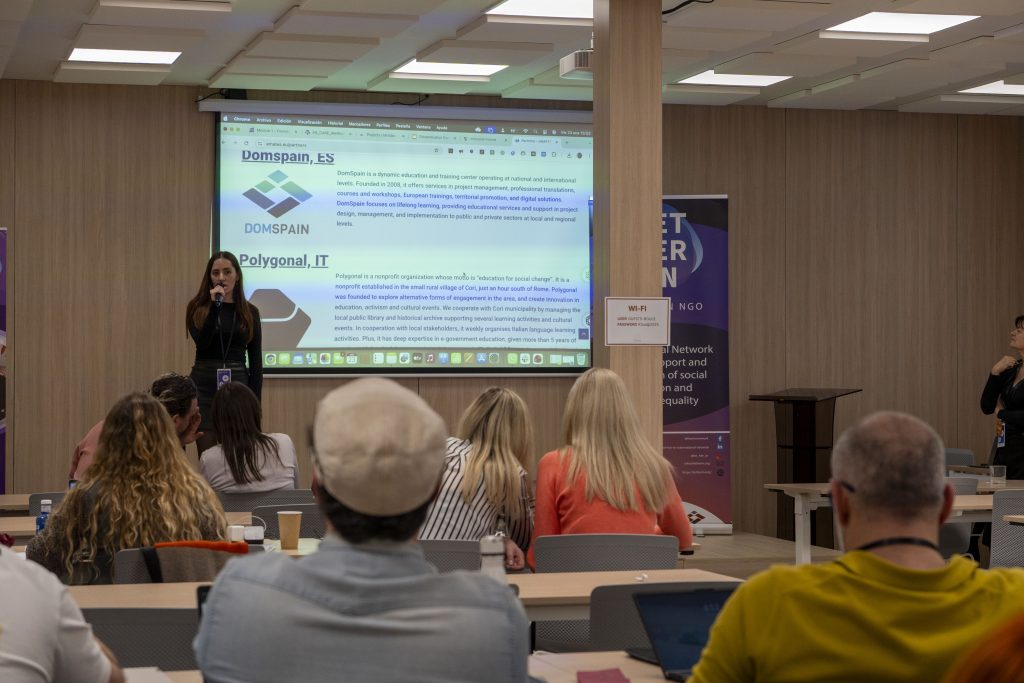
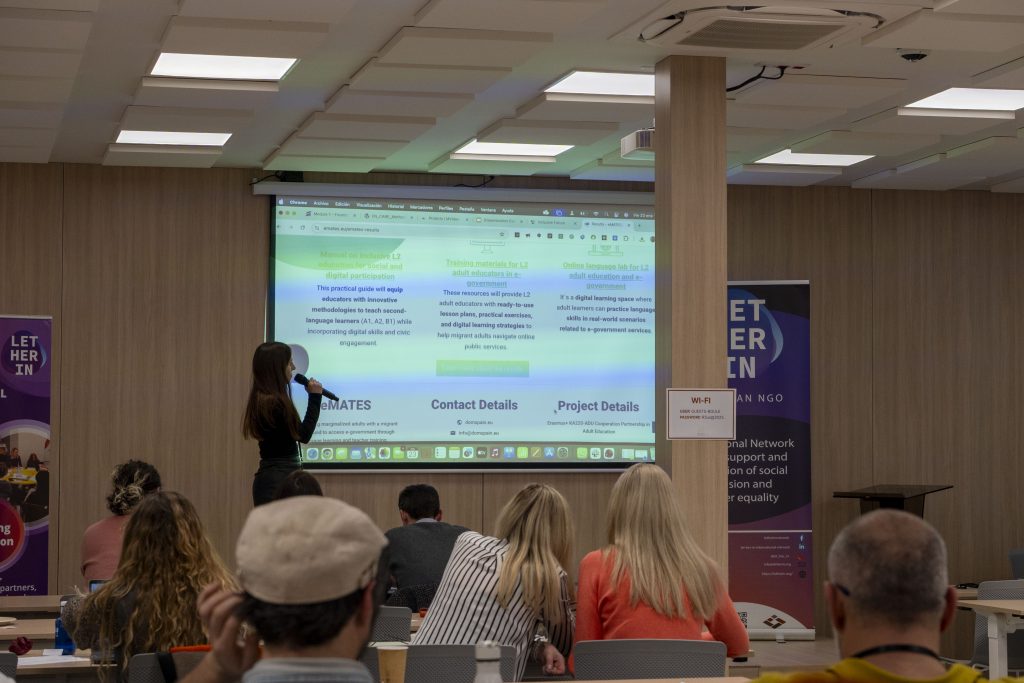
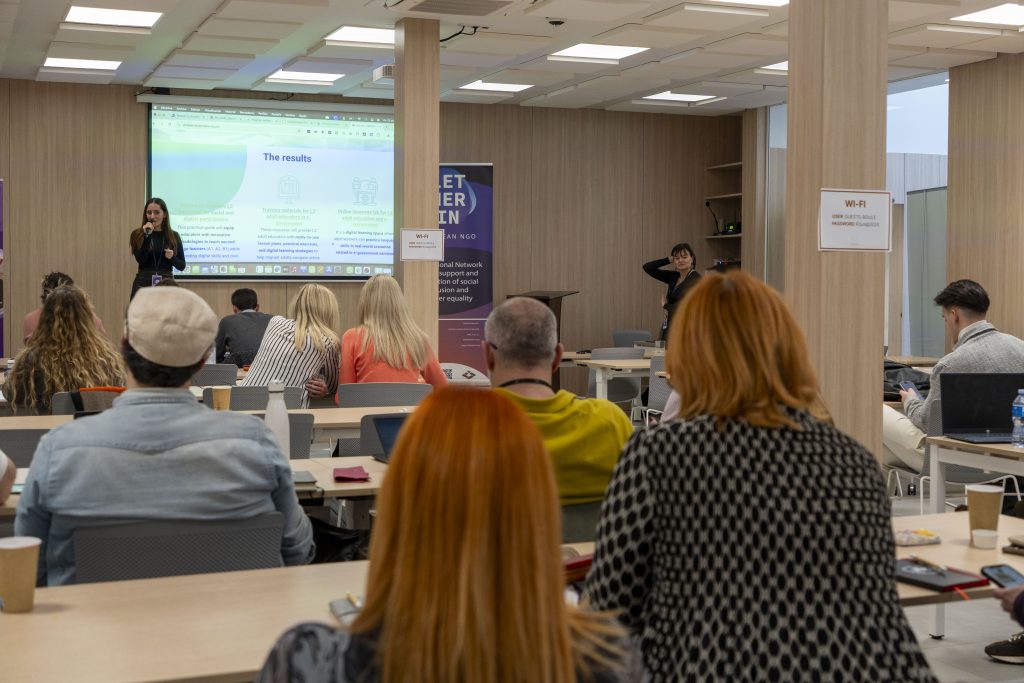
The eMATES project was presented during the International Let Her In assembly “Inclusion: a shared challenge”, held in Reus. The event brought together representatives from over twenty countries to share projects, exchange experiences and generate new synergies around inclusion, diversity, equality and participation.
This dissemination activity offered an important opportunity to introduce the work of the eMATES consortium to a wider international network of organisations active in education, training, social inclusion and European cooperation. The assembly created a valuable space to connect with professionals and institutions who share a common interest in making learning opportunities more accessible and relevant for people facing social, linguistic or digital barriers.
During the event, eMATES was presented as a practical response to a challenge that many adult educators know well: how to support migrant learners in developing not only language skills, but also the digital confidence needed to manage everyday online services. The presentation focused on the project’s training materials and their relevance for educators working in language learning, adult education, migrant inclusion and community support.
The eMATES training pathway is structured across A1, A2 and B1 and organised around six key areas of everyday life:
- Accessing Healthcare Services
- Navigating Job Search and Employment Platforms
- Managing Residency and Legal Documentation
- Using Online Banking and Financial Services
- Utilising Public Transport and Mobility Services
- Engaging with School and Parenting Platforms
These modules offer educators realistic classroom contexts where language learning is connected to practical digital tasks. Learners can practise identifying relevant information, understanding online instructions, completing forms, managing appointments, reading notifications and communicating through digital platforms. In this way, digital skills are not treated as an isolated topic, but integrated into language education through real-life situations.
For educators, this approach is especially relevant because it supports a more functional and inclusive way of teaching. The materials help bring learners’ real needs into the classroom and provide structured activities that can be adapted to different levels of language competence. This is particularly valuable for professionals working with adult migrants who may face combined barriers: limited language proficiency, unfamiliar administrative systems and low confidence in digital environments.
Presenting eMATES at “Inclusion: a shared challenge” was also highly relevant from a dissemination perspective. The Let Her In assembly included project presentations, networking sessions and spaces for co-creation and innovation, allowing participating organisations to exchange knowledge and explore future cooperation. Sharing eMATES in this context strengthened the visibility of the project beyond the consortium and helped position its results within broader European discussions on inclusion, adult learning and digital participation.
The event also reflected one of the central ideas behind eMATES: inclusion requires cooperation. By connecting with an international network of organisations committed to equal participation, the consortium was able to share its progress, gather interest from related sectors and contribute to a collective reflection on how education can help reduce barriers to access.
Through this dissemination action, eMATES continues to build its European visibility and relevance. The project shows how Erasmus+ cooperation can support educators with practical resources, empower migrant learners in their everyday lives and contribute to more inclusive communities.
#eMates #ErasmusPlus #DigitalInclusion #AdultEducation #ReusSpain